

National Library of Kosovo
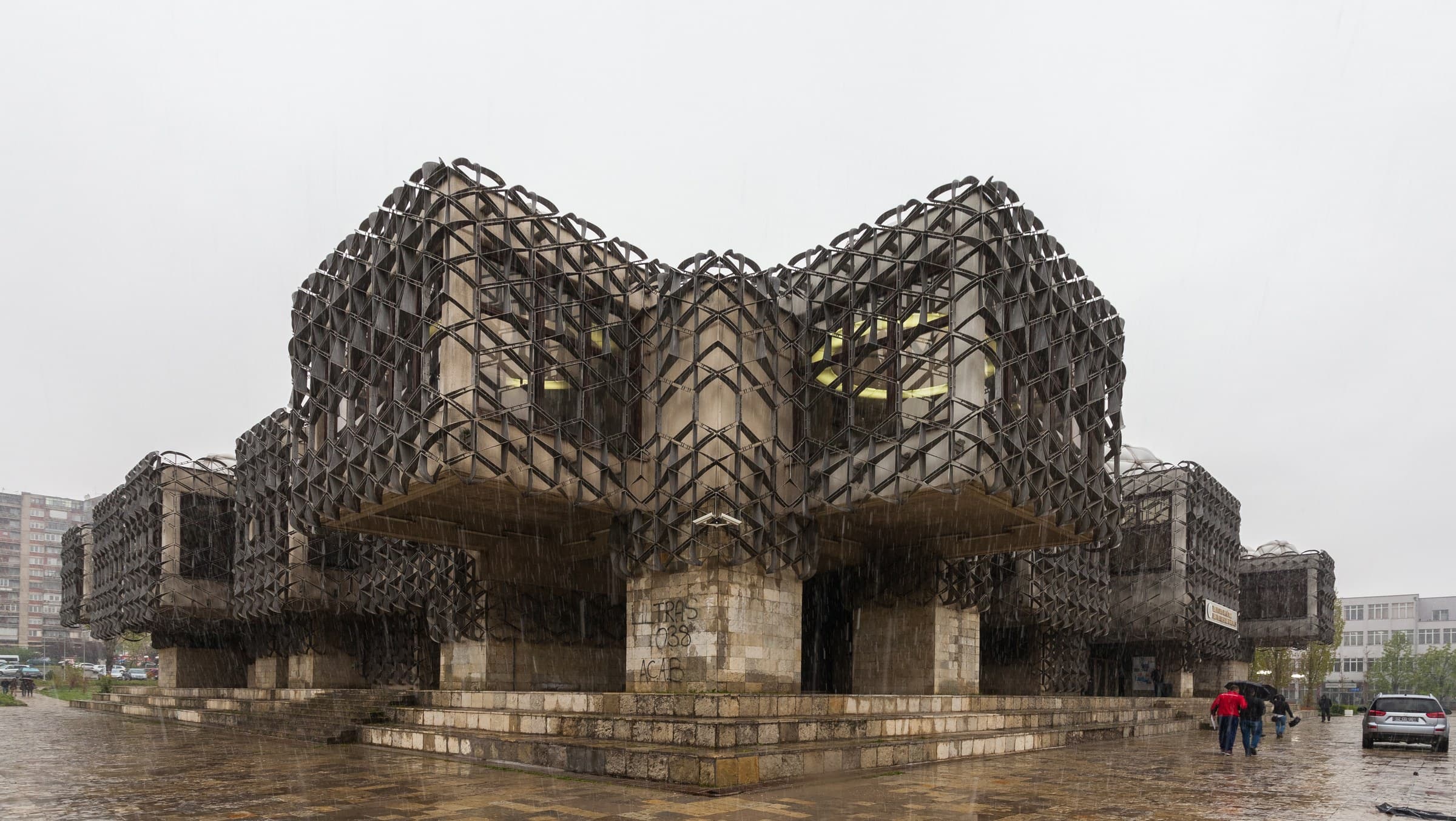
Library of 1982 by Andrija Mutnjaković, under ninety-nine domes and a steel lattice
Walk all the way round it before deciding; most people change their mind at least once.
University Quarter1980s ArchitectureBrutalism
In 60 seconds
Pristina is the youngest capital in Europe and does not look like any of the others. Ottoman Pristina survives in fragments — the Imperial Mosque of 1461, the Great Hammam, a pair of courtyard houses now holding the ethnographic museum — set among concrete from the socialist decades and a great deal of unplanned building since. Its most photographed structure is the National Library of 1982, ninety-nine domes under a steel net, which the city has never agreed about. What Pristina does unambiguously well is street life: a long pedestrian boulevard, a population whose median age is among the lowest on the continent, and a coffee culture to match.
Best for
Known for
Skip if
You travel for beautiful old towns; Pristina is interesting rather than handsome, and knows it.
Your match
Choose a few travel interests and we will show how well Pristina fits them. Choose interests
See
The things that would make the trip incomplete without them.
Library of 1982 by Andrija Mutnjaković, under ninety-nine domes and a steel lattice
Walk all the way round it before deciding; most people change their mind at least once.
Ottoman mosque of 1461, the oldest building still standing in the city
Small and easy to walk past; it is the one surviving thread back to the fifteenth-century town.
Two walled Ottoman houses of the Emin Gjiku compound, furnished as they were lived in
The best thing in the city: take the guided walk through the rooms rather than reading the labels.
Wide pedestrian boulevard through the centre, lined with cafés and ending at the squares
Join the evening walk; in a city short on monuments this is the main civic event.
Ottoman bath house beside the Imperial Mosque, restored and used for exhibitions
Worth ten minutes for the vaulting; what is on show inside changes often.
Eat
A short list, kept short on purpose. Each entry answers one question: when is this the right choice?
Too few picks yet for their own heading, so they share this list.
Grills and family restaurants off the boulevard serving qebapa, tava and stuffed peppers
Order qebapa with a plate of raw onion and bread; nothing here costs what it should.
A growing number of restaurants reworking Kosovan food with local produce and wine
The most interesting food in the country right now; book, because the good rooms are small.
Dozens of cafés along and off Mother Teresa Boulevard, busy from early morning
Order a macchiato and sit for an hour; this is the single most characteristic thing to do in Pristina.
Beyond the obvious
Less obvious, rarely queued for, and usually the part people remember.
Large wooded park on the hill at the city's eastern edge, with paths and a swimming pool
Where Pristina escapes itself at the weekend; twenty minutes from the boulevard into real forest.
Excavated Roman city on the plain south-east of Pristina, beside Gračanica
Largely unvisited and only partly dug; combine it with the monastery a few minutes away.
After dark
Bars and small music venues in the lanes behind the boulevard
A genuinely young crowd and late hours; the side streets are where it happens, not the main drag.
Orientation
How the city is actually divided, and what each part is for.
The boulevard, the squares, the cafés and the government quarter around them
Flat, busy and walkable, and where you will spend nearly all your time.
The surviving Ottoman fragment: the Imperial Mosque, the hammam and the museum houses
Small and interleaved with modern blocks; walk it with a map or you will miss half of it.
Stay
Areas rather than hotels — pick the right one and the rest follows.
Hotels and apartments on and around the boulevard, walking distance from everything
The only sensible choice; the city's interest is concentrated in a few central streets.
Practical
Plan this trip — useful links
Context
Enough to make what you are looking at legible.
The Roman city of Ulpiana stood on the plain a short way south-east of the modern centre.
The Imperial Mosque was built under Ottoman rule, and the town developed as a regional market centre.
As the capital of the autonomous province, Pristina was rebuilt on a socialist plan, gaining its university and library.
The Kosovo War and the NATO intervention of 1999 brought large-scale displacement across Kosovo and into the capital.
Kosovo declared independence; its status remains disputed, and the United Nations continues to apply Resolution 1244 to the territory.
Further out
Worth a day if you have one to spare.
Monastery of 1321 on the plain outside the capital, part of a UNESCO World Heritage property
The closest of the four medieval monuments, and easily the easiest to reach from Pristina.
Ruined fortress of a medieval silver-mining town on a hill east of the capital
An empty hill, a broken keep and a long view; take a picnic, because there is nothing up there.