
Traveleriences
Zagreb's St. Mark's Church with its distinctive tiled heraldic coat of arms roof in the Upper Town

Zagreb, Croatia

Ideal: 2–4 daysBest: Apr–Jun, Sep–Oct, DecPrice: Moderate

In 60 seconds

Zagreb in 60 seconds

Croatia's capital is a relaxed, walkable Central European metropolis built in two distinct tiers: the cobblestoned medieval heights of Gornji Grad (Upper Town) with gas lanterns lit by hand each twilight, and the grand 19th-century Austro-Hungarian boulevards of Donji Grad (Lower Town) arranged around a green horseshoe of parks. Between open-air Dolac farmers' market, world-class café terraces and the quirky Museum of Broken Relationships, Zagreb charms effortlessly year-round.

Food

Best for

  • Culture
  • Architecture
  • Museums
  • Weekend

Known for

  • St. Mark's Church tiled roof
  • Museum of Broken Relationships
  • Dolac Market
  • Green Horseshoe parks

Skip if

You are exclusively looking for coastal beaches and turquoise sea swims; Zagreb is a landlocked inland capital with rich urban cultural life.

Your match

Choose a few travel interests and we will show how well Zagreb fits them. Choose interests

See

Must experience

The things that would make the trip incomplete without them.

Lotrščak Tower & Funicular

Inexpensive

13th-century cannon tower · 66-metre historic funicular railway

Ride the blue 1890 funicular up to the Upper Town and cover your ears at noon when the Grič cannon fires its daily salute.

Gornji GradFunicularHistoric

Museum of Broken Relationships

Moderate

Internationally acclaimed concept museum showcasing donated mementos of past romances

A deeply moving and humorous exhibition in a baroque palace displaying personal objects and poignant anonymous stories from across the globe.

Gornji GradConceptEmotional

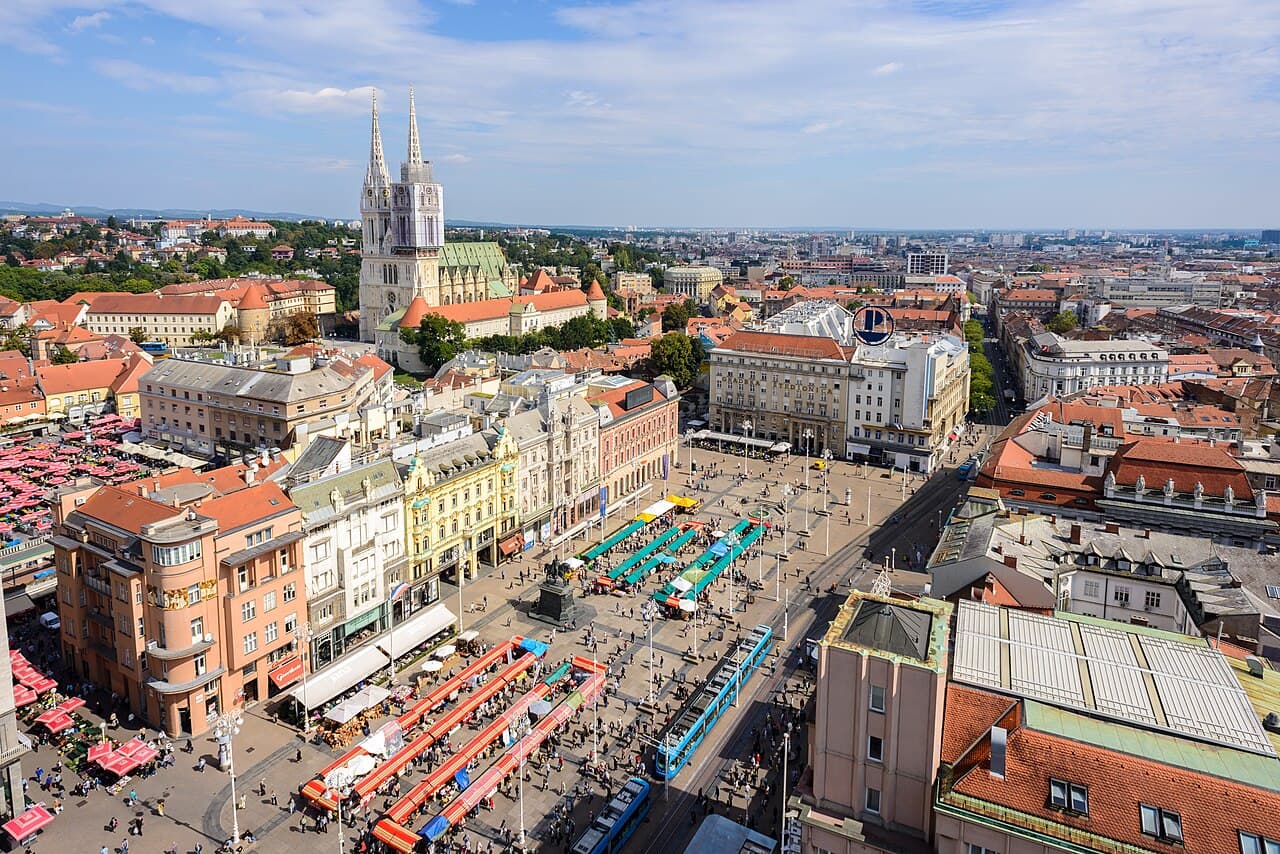
Dolac Farmers' Market

Inexpensive

Open-air market known as 'the belly of Zagreb' beneath sea of red umbrellas

Browse fresh cheeses from local kumice grandmothers, seasonal berries and fresh flowers on the elevated terrace just above the main square.

Gornji GradFoodLocal culture

Ban Jelačić Square & Donji Grad

Inexpensive

Sprawling central pedestrian hub, yellow trams & Austro-Hungarian Lenuzzi Horseshoe

Watch Zagreb's iconic blue trams criss-cross the main square and stroll through Zrinjevac park pavilions along the green boulevard ring.

Donji GradParksSquares

Mirogoj Cemetery Arcades

Inexpensive

Monumental ivy-covered neo-Renaissance cemetery arcades designed by Hermann Bollé

Take bus #106 north to explore one of Europe's most beautiful cemeteries, featuring cupolas, tiled domes and sculptures by Ivan Meštrović.

MedveščakArchitectureMonument

Maksimir Park

Inexpensive

18th-century English landscape park with oak forests, five lakes & Swiss chalet

Escape the city centre in Southeast Europe's oldest public park, enjoying peaceful wooden footbridges and serene lake views.

MaksimirLakesNature

Eat

Where to eat

A short list, kept short on purpose. Each entry answers one question: when is this the right choice?

Local

Where to eat the food this city is actually known for.

Vinodol

Expensive

Institution of traditional continental and Dalmatian gastronomy with vaulted brick courtyard

A bustling, reliable downtown classic for Zagorski štrukli (baked cheese pastry), slow-roasted veal under the peka and handmade pasta.

Donji GradCourtyardInstitution

Baltazar

Expensive

Historic Kaptol tavern known for premium charcoal grills and Zagreb classics

A long-time meeting ground for local politicians and writers enjoying Zagrebački odrezak (veal schnitzel stuffed with ham and cheese).

KaptolClassicGrill

Coffee & fika

Mornings, and the slow hour between things.

Cogito Coffee Shop

Inexpensive

Boutique specialty roastery tucked down a leafy courtyard on Varšavska

The birthplace of Croatia's modern specialty coffee movement, roasting pristine single-origin coffees with outdoor picnic benches.

Donji GradCourtyardEspresso

Eli's Caffe

Inexpensive

Croatia's first specialty coffee bar on Ilica, founded by barista champion Nik Orosi

A minimalist haven strictly focused on the craft of espresso without smoking, syrup or distractions.

Donji GradMinimalistPioneering

Kavana Palainovka

Inexpensive

Oldest café in Zagreb operating since 1847 on quiet Ilirski trg

Sit beneath chestnut trees on the peaceful northern square of Gornji Grad for traditional Turkish coffee or a glass of Pelinkovac.

Gornji GradHistoricQuiet

More places to eat

Too few picks yet for their own heading, so they share this list.

Mali Bar

Moderate

Charming second-floor courtyard bistro by chef Ana Ugarković

Tucked down a quiet courtyard off Vlaška, serving creative, ever-changing Mediterranean-continental small plates with warm hospitality.

Donji GradBistroCourtyard

Noel

Very expensive

Zagreb's celebrated Michelin-starred fine dining destination on Popa Dukljanina

Sophisticated culinary innovation marrying contemporary Croatian produce with precise European technique and top-flight wine pairings.

Donji GradFine diningMichelin

Beyond the obvious

Hidden gems

Less obvious, rarely queued for, and usually the part people remember.

Grič Tunnel

Inexpensive

World War II pedestrian tunnel running straight through the bedrock below the Upper Town

Walk through this 350-metre illuminated historic bomb shelter linking Mesnička and Radićeva streets away from street traffic.

Gornji GradCoolHistory

After dark

Bars & nightlife

Bornstein Wine Bar & Shop

Moderate

Croatia's first private wine shop in a 200-year-old vaulted brick cellar on Kaptol

Descend into brick vaults beneath the cathedral to taste rare vintage bottles and curated flights from all wine regions of Croatia.

KaptolHistoric cellarTastings

Craft Room

Moderate

Multi-tap craft beer bar with balcony overlooking bustling Opatovina street

A craft beer hotspot with 12 rotating draft taps highlighting independent Croatian microbreweries like Zmajska, Nova Runda and Varionica.

Gornji GradBalconyCraft beer

Swanky Monkey Garden

Moderate

Industrial-chic outdoor courtyard cocktail terrace with plunge pool

A leafy, multi-level terrace tucked inside a converted 19th-century dry cleaners off Ilica, popular for weekend cocktails and guest DJs.

Donji GradCocktailsCourtyard

Orientation

Neighbourhoods

How the city is actually divided, and what each part is for.

Gornji Grad & Kaptol

The historic medieval twin hills overlooking the modern metropolis

Atmospheric, quiet and romantic with cobblestone lanes, gas lamps, government palaces and panoramic viewing terraces.

Donji Grad (Lower Town)

19th-century Austro-Hungarian grid with museums, grand cafes and parks

Vibrant and elegant, packed with bustling shopping avenues, open-air café terraces on Bogovićeva and manicured park promenades.

Stay

Where to stay

Areas rather than hotels — pick the right one and the rest follows.

Upper Town (Gornji Grad)

Expensive

Boutique heritage apartments tucked in historic cobblestone alleys

Ideal for romantic weekend getaways and quiet nights, steps away from the funicular and St. Mark's Square.

CharmingHistoric

Lower Town (Donji Grad)

Moderate

Central grand hotels and stylish modern apartments near Ban Jelačić Square

The most convenient base for first-time visitors, placing restaurants, tram lines and museums right on your doorstep.

CentralTransit

Practical

Know before you go

Getting in
Zagreb Franjo Tuđman Airport (ZAG) is 15 km southeast; Pleso Prijevoz shuttle buses link directly to the Central Bus Station in 30 minutes.
Getting around
The ZET tram system covers the city cleanly and efficiently. Single tickets bought at Tisak newsstands cost under one euro.
Café culture
Zagreb's ritual of 'špica'—lingering on Saturday mornings over coffee on pedestrian Bogovićeva and Cvjetni trg—is an essential cultural experience.
Advent in Zagreb
In December, Zagreb transforms into one of Europe's premier Christmas market destinations with open-air ice rinks and food chalets across Zrinjevac.

Plan this trip — useful links

Context

History in 5 minutes

Enough to make what you are looking at legible.

  1. 1094

    King Ladislaus of Hungary founds the diocese of Zagreb on the hill of Kaptol, while neighbouring Gradec develops into a fortified artisan town.

  2. 1242

    King Béla IV issues the Golden Bull declaring Gradec a free royal town following devastating Mongol invasions.

  3. 1850

    Gradec, Kaptol and surrounding settlements officially merge under the first mayor Janko Kamauf to create the unified modern city of Zagreb.

Further out

Nearby escapes

Worth a day if you have one to spare.

Samobor Medieval Town

Idyllic market town famous for cream cakes (kremšnite) and castle ruins

Wander along the Graduate stream to the town square to indulge in warm, fluffy vanilla Samoborske kremšnite at Kavana Livadić.

30 minutes by bus or carCakesCastle

Mount Medvednica & Sljeme

1,033-metre forested mountain rising behind the city with modern cable car

Ride the Sljeme cable car to the summit to hike dense beech forests and dine on hearty bean stew with sausage at mountain lodges.

25 minutes by tram and cable carAlpine tavernCable car