
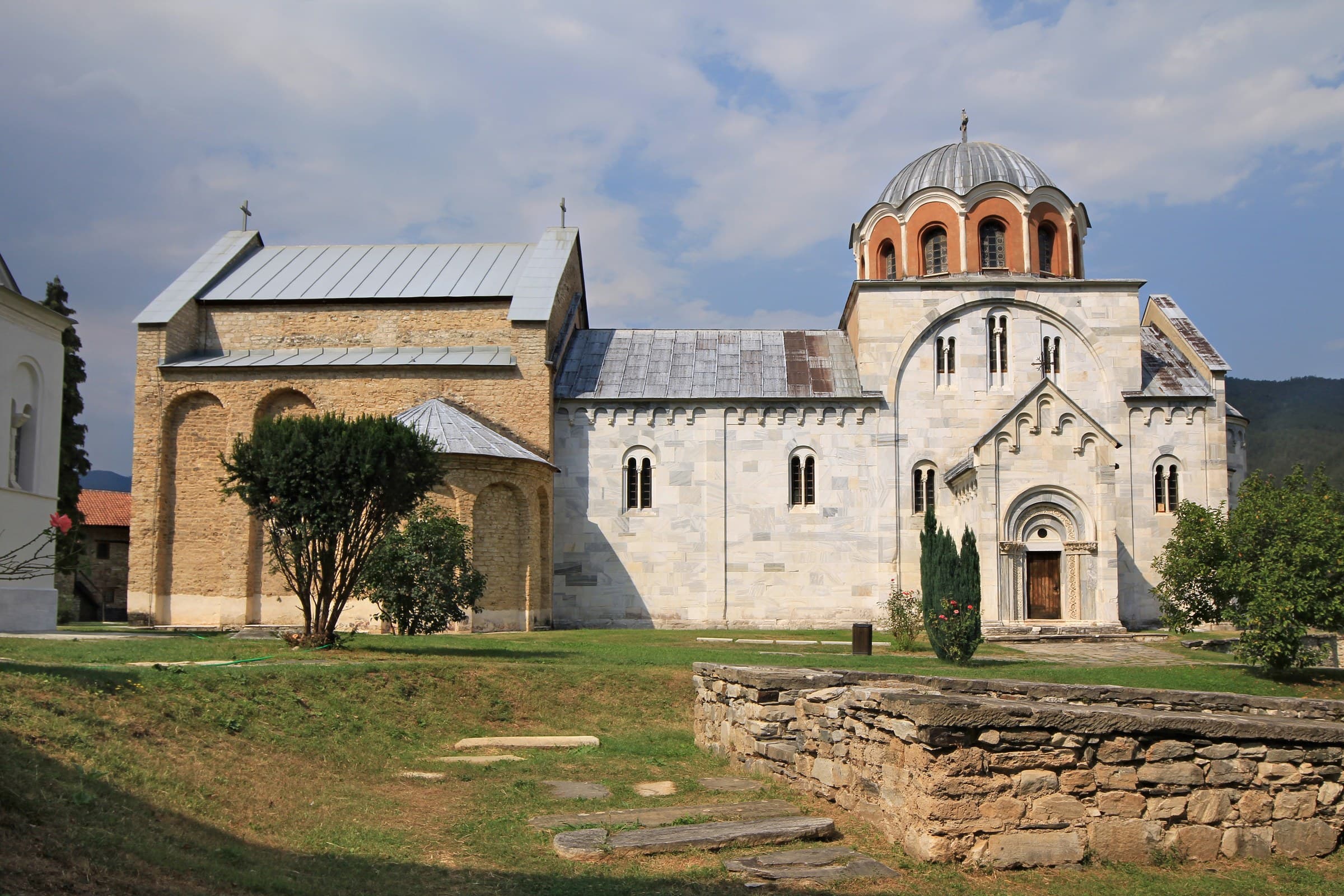
Studenica Monastery
Stefan Nemanja's foundation of 1190 within circular walls, faced in white and grey marble
Give the Church of the Virgin an unhurried hour; the 1209 Crucifixion is the reason the whole valley matters.

In 60 seconds
The Ibar valley south of Kraljevo is called the Valley of Kings, and the name is earned: within an hour's drive lie Studenica, the marble monastery Stefan Nemanja founded in 1190 and the richest of the medieval Serbian houses; Žiča, where Serbian kings were crowned; and Maglič, a thirteenth-century fortress on a rock in a bend of the river. Studenica's Church of the Virgin is faced in polished white marble, and its frescoes of 1209 are among the defining works of the Raška school. Kraljevo itself is a plain working town with a wide central square, useful mainly as the base from which all of this is reached — which is exactly what it has been since it took the king's name in 1882.
Best for
Known for
Skip if
You are not drawn to churches and medieval painting; strip those out and the valley is simply pleasant countryside.
Your match
Choose a few travel interests and we will show how well Studenica & Kraljevo fits them. Choose interests
See
The things that would make the trip incomplete without them.
Stefan Nemanja's foundation of 1190 within circular walls, faced in white and grey marble
Give the Church of the Virgin an unhurried hour; the 1209 Crucifixion is the reason the whole valley matters.
Small cruciform chapel of 1314 endowed by King Milutin, densely painted inside
Easy to walk past in the courtyard, and the better fresco cycle of the two; look for the Birth of the Virgin.
Early 13th-century coronation monastery of the Serbian kings, its walls washed deep red
Three kilometres from Kraljevo and reachable by local bus — the easiest of the valley's monasteries to fit in.
13th-century fortress with seven towers on a rock above a bend of the Ibar
The view from the road below is the famous one; the climb up is steep, unshaded and worth it.
Town museum covering the Ibar valley's archaeology, medieval art and 20th-century history
A sensible first stop for context on the monasteries before driving out to them.
Eat
A short list, kept short on purpose. Each entry answers one question: when is this the right choice?
Too few picks yet for their own heading, so they share this list.
Grills and kafane around Kraljevo's wide central square, cooking central Serbian standards
Ask for whatever is under the sač that day; it is the one thing worth ordering over the grill.
Roadside restaurants along the Ibar and the Studenica road serving river trout and lamb
Stop on the drive back from Studenica rather than eating in town; the trout is better at the river.
Terrace cafés ringing the central square, busy from mid-morning until late
The square is the town's whole social life; sit on it once and you have seen Kraljevo.
Beyond the obvious
Less obvious, rarely queued for, and usually the part people remember.
Cells and chapels cut into the gorge walls above the monastery, reached on marked forest paths
Follow the path up the Studenica gorge for an hour; almost nobody who visits the monastery does.
Faded sulphur spa on the Ibar, with interwar bath buildings and a riverside park
Go for the atmosphere of a spa town that time left alone rather than for the treatments.
Orientation
How the city is actually divided, and what each part is for.
Wide pedestrian square with the warriors' monument, the museum and the town's cafés
Compact and unpretentious: a base rather than a sight, and perfectly good at being one.
Wooded side valley off the Ibar holding the monastery, its hermitages and a few hamlets
Stay a night out here if you can; the monastery at dusk, with the gates shut, is a different place.
Stay
Areas rather than hotels — pick the right one and the rest follows.
Hotels and apartments around the central square, with the best transport links in the valley
The practical choice: everything in the valley is within an hour, and the coaches all stop here.
Monastery guest accommodation and village rooms in the valley below the walls
Simple and early-rising; worth it for the chance to be at the church before the first coach arrives.
Practical
Plan this trip — useful links
Context
Enough to make what you are looking at legible.
Stefan Nemanja founded Studenica and endowed it with the marble Church of the Virgin before retiring to Mount Athos.
The Church of the Virgin was painted, including the Crucifixion that became a touchstone of the Raška school.
Žiča was completed as the seat of the new Serbian archbishopric and the church in which kings were crowned.
Maglič was raised on its rock above the Ibar to guard the road between the monasteries and the royal seats.
The market town of Rudo Polje was renamed Kraljevo, the king's town, after the coronation of Milan Obrenović.
Studenica Monastery was inscribed on the UNESCO World Heritage List.
Further out
Worth a day if you have one to spare.
Forested mountain above Kraljevo with marked walking trails and a small ski area
An easy half-day of beech forest and quiet trails when the monasteries have begun to blur together.
Ottoman bazaar town in the Raška valley with its own group of UNESCO-listed monasteries
The natural next stop south, and the pair of valleys together tell the whole medieval story.