
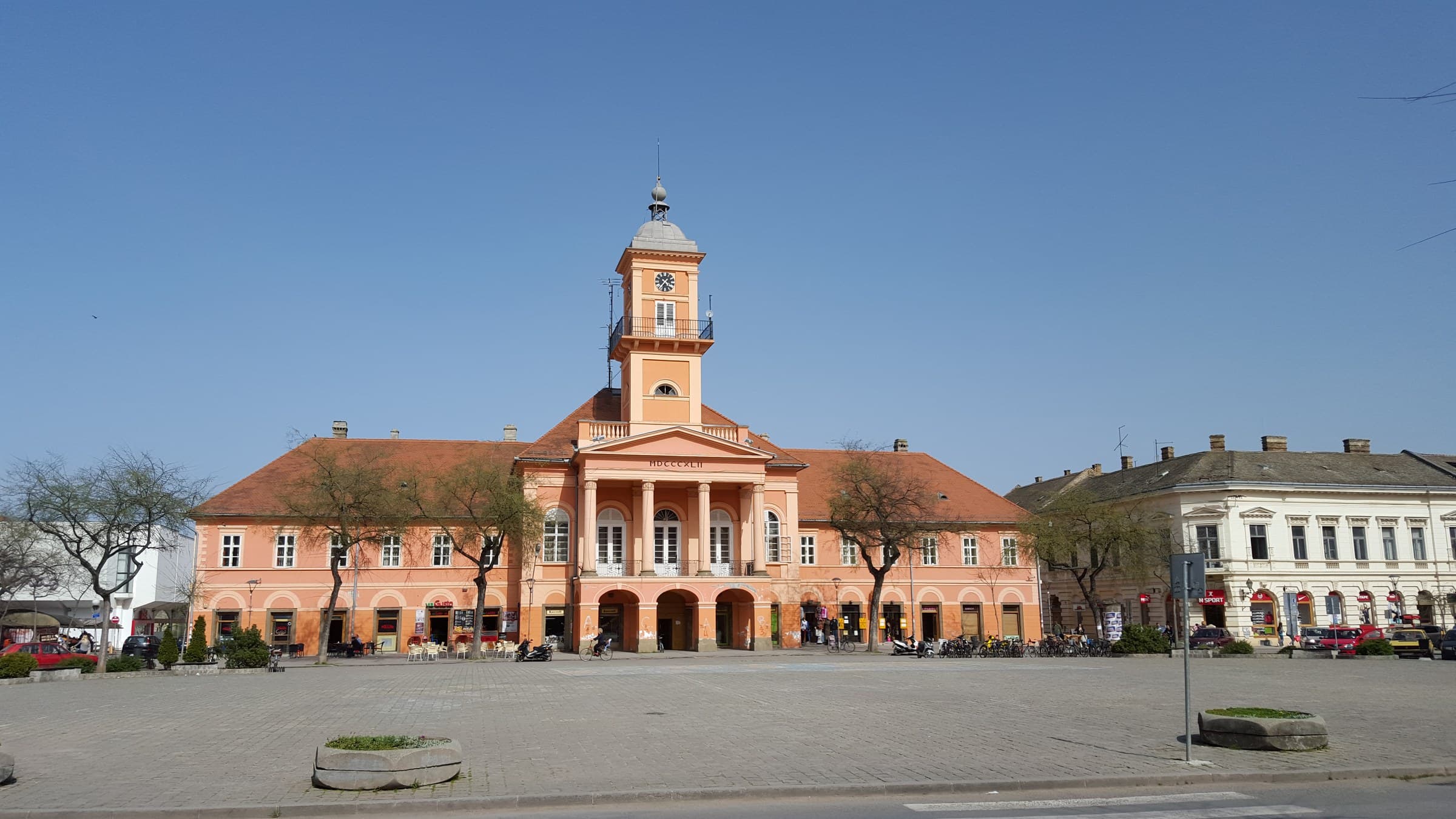
County Hall (Županija)
Neoclassical county seat of 1808 whose ceremonial hall holds Serbia's largest oil painting
Ask at the desk to be let into the ceremonial hall, where Eisenhut's battle canvas fills an entire wall.

In 60 seconds
Sombor sits on the flat Bačka plain of northern Vojvodina and is the most comprehensively green town in Serbia — thousands of European nettle trees line the Venac, the horseshoe of boulevards laid out where the old moat once ran, so that the whole centre is walked in shade. The County Hall of 1808 holds Ferenc Eisenhut's vast canvas of the 1697 battle at Zenta, the largest oil painting on canvas in the country. Around it lie a neoclassical magistrate, the Serbian teachers' college founded here in 1778, and the gallery of Milan Konjović, the painter who spent a lifetime turning this pale plain into fierce ochre and blue. Horse-drawn carriages still work the streets, and the Danube backwaters of Gornje Podunavlje begin a short drive west.
Best for
Known for
Skip if
You want hills, nightlife or a long list of sights; Sombor is a quiet provincial town best taken at walking pace.
Your match
Choose a few travel interests and we will show how well Sombor fits them. Choose interests
See
The things that would make the trip incomplete without them.
Neoclassical county seat of 1808 whose ceremonial hall holds Serbia's largest oil painting
Ask at the desk to be let into the ceremonial hall, where Eisenhut's battle canvas fills an entire wall.
Horseshoe of shaded boulevards on the line of the old moat, protected as heritage of great importance
Walk the full horseshoe in one slow loop; it is the clearest way to understand how the town is laid out.
Gallery devoted to the Sombor painter who spent six decades reworking the Pannonian landscape
Follow the rooms in order to watch his palette move from grey realism into the blazing yellows of his Blue Phase.
Town museum covering Bačka's archaeology, crafts and civic life across a large standing collection
Go for the rooms on plain agriculture and the draining of the marshes, which explain the whole landscape outside.
Eat
A short list, kept short on purpose. Each entry answers one question: when is this the right choice?
Too few picks yet for their own heading, so they share this list.
Town and backwater kitchens serving the Bačka river-fish stew cooked slowly with sweet paprika
Order riblji paprikaš with a plate of wide homemade noodles; it is the one dish the whole district argues about.
Terrace cafés ranged under the nettle trees along the main square and the Venac
Take a long morning coffee outside and watch a carriage go by; this is the whole point of Sombor.
Beyond the obvious
Less obvious, rarely queued for, and usually the part people remember.
Building of the Serbian teachers' college founded in Sombor in 1778, still in educational use
Stand in the courtyard and consider that Serbian schoolteachers have been trained on this spot since 1778.
Carmelite baroque church on the main square, quiet and largely unvisited
Step in for ten minutes of cool silence; the interior is plainer and more affecting than the facade suggests.
Orientation
How the city is actually divided, and what each part is for.
The whole area inside the Venac: squares, the county hall, galleries and low ochre townhouses
Everything worth seeing in Sombor is inside the horseshoe, and all of it is flat.
Stay
Areas rather than hotels — pick the right one and the rest follows.
Small hotels and guesthouses within the shaded horseshoe, a few minutes from everything
Stay inside the horseshoe; the town is small enough that anywhere else means walking in for every meal.
Practical
Plan this trip — useful links
Context
Enough to make what you are looking at legible.
A settlement called Czoborszentmihály grew around a fortified manor of the Czobor family on the Bačka plain.
Taken from Ottoman rule, the town was resettled and in 1749 bought the status of a free royal city from the Habsburg crown.
As seat of Bács-Bodrog county Sombor built its county hall, magistrate and schools, and the Venac was laid out on the filled moat.
Joined the Kingdom of Serbs, Croats and Slovenes in 1918 and remained a quiet administrative and teaching town of Vojvodina.
Further out
Worth a day if you have one to spare.
Vast Danube floodplain of oxbows, willow forest and backwaters on the Croatian border
Take a guided boat into the backwaters at first light, when herons and white-tailed eagles are still working the water.
Border village on the Danube with a 19th-century brick lock chamber and a damask weaving tradition
Walk out onto the old lock to watch a barge drop through, then look for Bezdan's woven damask in town.