

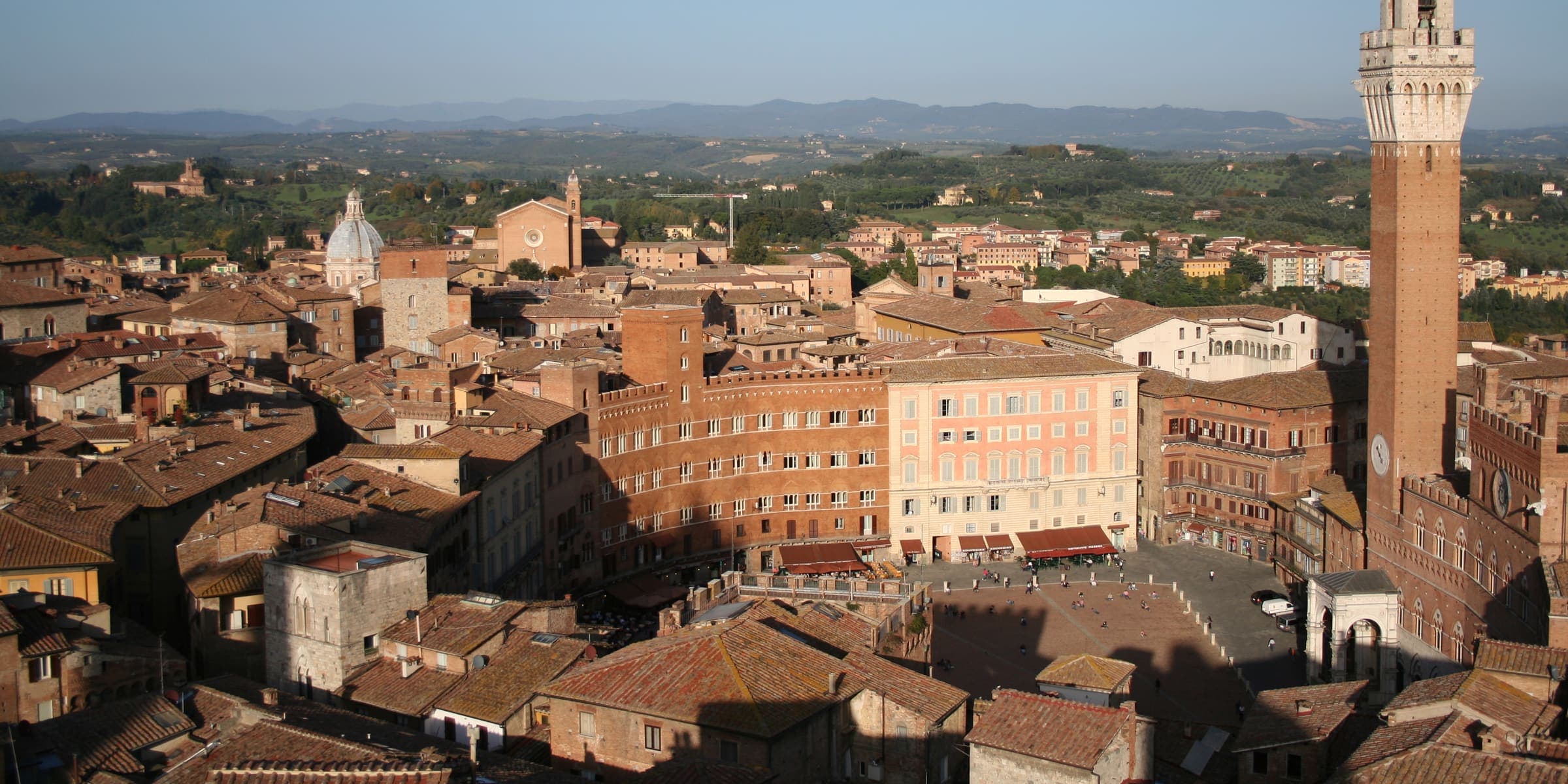
Piazza del Campo & Torre del Mangia
The shell-shaped square and its tower
Sit on the sloping bricks like everyone else, then climb the town hall's tower for the view over the rooftops.
CentroFreeMust-see
In 60 seconds
Siena is the Gothic counterpart to Renaissance Florence: a hill city of brick lanes that all run down to Piazza del Campo, the shell-shaped square where the Palio horse race is run twice a summer, on 2 July and 16 August, by riders from the city's rival districts. Climb the Torre del Mangia, then cross to the striped cathedral, whose inlaid marble floor and painted Piccolomini Library are among Italy's great sights. North of the city, between Siena and Florence, lies Chianti Classico — wooded hills, cypress drives, castles that are now wineries and villages such as Castellina, Radda and Panzano, where a butcher recites Dante over the bistecca. South, the Val d'Orcia's rolling fields lead to Pienza and Montalcino. Three days, with a car for the hills.
Best for
Known for
Skip if
You want to see Tuscany without a car — Siena is fine by bus, but Chianti and the Val d'Orcia really need one.
Your match
Choose a few travel interests and we will show how well Siena & Chianti fits them. Choose interests
See
The things that would make the trip incomplete without them.
The shell-shaped square and its tower
Sit on the sloping bricks like everyone else, then climb the town hall's tower for the view over the rooftops.
Striped marble, inlaid floor and the Piccolomini Library
Black-and-white marble everywhere, a floor of inlaid scenes, and a library painted by Pinturicchio in colours still fresh.
A bareback horse race round the Campo
Ninety seconds of chaos on 2 July and 16 August, after days of pageantry; stand in the centre of the square for free, or book a balcony.
Castellina, Radda, Gaiole and Panzano
Drive the winding roads between hill villages and castle wineries; taste Chianti Classico where the black rooster is on every label.
Eat
A short list, kept short on purpose. Each entry answers one question: when is this the right choice?
Too few picks yet for their own heading, so they share this list.
Creative Tuscan cooking in an old pharmacy
Dark wooden shelves of the old pharmacy and modern Tuscan dishes, a few steps from the Campo.
Dining in rooms cut into the rock
Sienese dishes in candlelit cellars carved from the tufa, near the cathedral.
Old Sienese pasticceria
Stand at the bar for coffee and a slice of panforte or a ricciarello, Siena's almond biscuit.
Beyond the obvious
Less obvious, rarely queued for, and usually the part people remember.
A walled village crowned with towers
A complete ring of 13th-century walls on a hilltop; walk the ramparts at sunset.
Dario Cecchini's butcher's shop
A theatrical butcher who serves meat-heavy set menus upstairs; the shop itself is part of Panzano life.
Orientation
How the city is actually divided, and what each part is for.
Seventeen rival districts
Each has its own flag, church, fountain and museum; look for the animal emblems on the street corners.
Stay
Areas rather than hotels — pick the right one and the rest follows.
Hotels in the car-free centre
Stay in the city for evenings in the Campo once the day trippers have gone.
Agriturismi among the vineyards
A farm with a pool and its own wine is the classic Chianti stay.
Practical
Plan this trip — useful links
Context
Enough to make what you are looking at legible.
The Council of Nine governs Siena's golden age; the Campo and the town hall are built.
The Black Death kills much of the population and halts the cathedral's vast enlargement.
Grand Duke Cosimo III defines the boundaries of the Chianti wine zone, among the first in the world.
Siena's historic centre is inscribed on the UNESCO World Heritage list.
Further out
Worth a day if you have one to spare.
UNESCO-listed hills, Pecorino and Brunello
The cypress-lined landscape of the postcards, Pienza's Renaissance square and Montalcino's Brunello cellars.
The town of towers
Fourteen surviving medieval towers; come early or late to miss the coaches.