

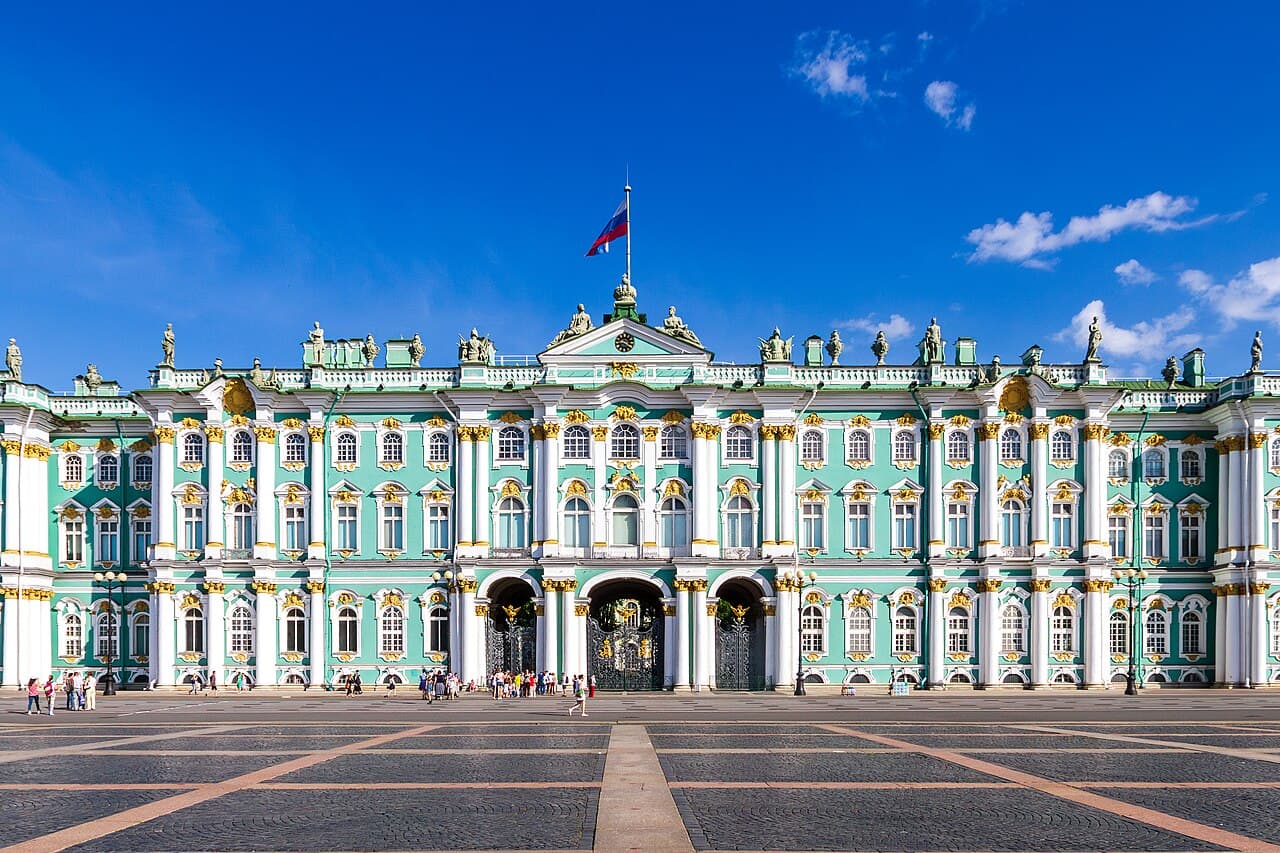
State Hermitage Museum & Winter Palace
Bartolomeo Rastrelli's 1754–1762 imperial palace on the Neva embankment
Five interconnected buildings housing European painting, classical antiquities and Scythian gold.
In 60 seconds
Laid out across the islands of the Neva delta from 1703, Saint Petersburg's UNESCO-listed historic centre is one of Europe's largest planned Baroque and Neoclassical ensembles. Walk from the Peter and Paul Fortress across the Trinity Bridge to Palace Square and the State Hermitage, follow the Fontanka, Moyka and Griboyedov canals beneath cast-iron footbridges, and pair the city with the Gulf of Finland fountains at Peterhof or Tsarskoye Selo.
Best for
Known for
Skip if
Official travel advisories currently warn against all travel to Russia.
Your match
Choose a few travel interests and we will show how well Saint Petersburg fits them. Choose interests
See
The things that would make the trip incomplete without them.
Bartolomeo Rastrelli's 1754–1762 imperial palace on the Neva embankment
Five interconnected buildings housing European painting, classical antiquities and Scythian gold.
1703 island citadel and Domenico Trezzini's golden-spired Baroque cathedral
Marks the founding core of the city on Zayachy Island.
Auguste de Montferrand's nineteenth-century granite-columned cathedral
Its colonnade walkway commands a 360-degree view over the Neva, Admiralty and Bronze Horseman.
Carlo Rossi's 1825 neoclassical palace off Arts Square
Chronicles Russian art from twelfth-century Novgorod icons to Kazimir Malevich.
Beyond the obvious
Less obvious, rarely queued for, and usually the part people remember.
1883–1907 Revival church covered inside with over seven thousand square metres of mosaics
Stands directly on the Griboyedov Canal embankment.
Eighteenth-century gravity-fed fountain cascade overlooking the Gulf of Finland
Part of the broader UNESCO World Heritage serial property surrounding the city.