

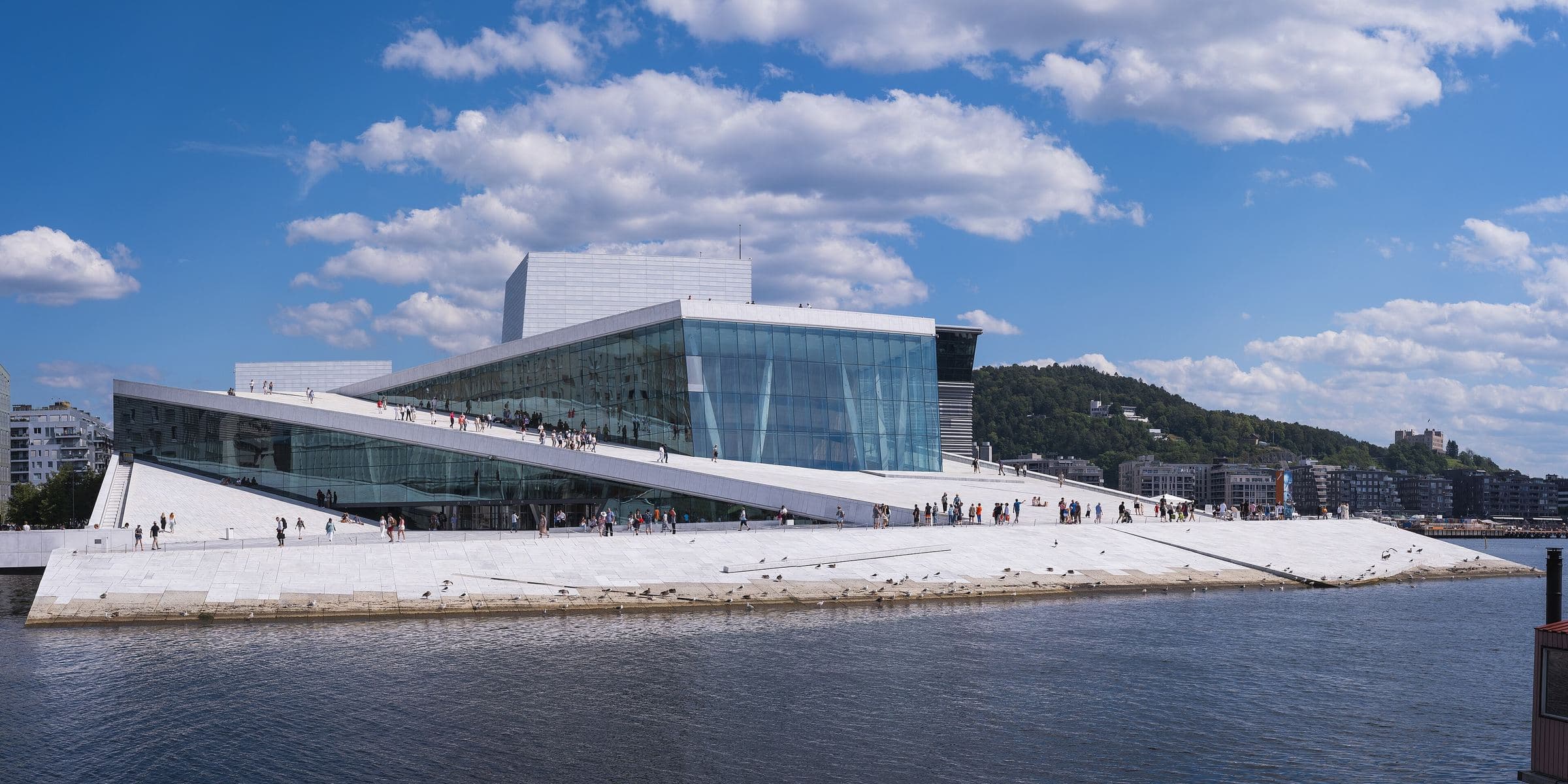
Oslo Opera House
Walk on the roof
A marble-and-glass opera house sloping into the fjord; climb its roof for the view.
BjørvikaArchitectureFree
In 60 seconds
Oslo has reinvented its waterfront: you can walk on the roof of the Opera House, then on to the new Munch museum and the National Museum. Behind the city the forest begins at the end of the metro lines, and in summer the islands of the fjord are a ferry ride away. Trams, metro and the island ferries run on the same ticket, bought on your phone. Swim from the harbour at Sørenga, cross to Bygdøy for its museums and beaches, and end the day in a floating sauna on the fjord. It is expensive and compact; two or three days is right.
Best for
Known for
Skip if
You are on a tight budget — Oslo is among Europe's most expensive cities — or want long winter days.
Your match
Choose a few travel interests and we will show how well Oslo fits them. Choose interests
See
The things that would make the trip incomplete without them.
Walk on the roof
A marble-and-glass opera house sloping into the fjord; climb its roof for the view.
Edvard Munch's museum
A tall new museum on the waterfront holding the largest Munch collection, including versions of The Scream.
Gustav Vigeland's sculpture park
More than 200 sculptures of human life in Frogner Park, free and always open.
Floating saunas and fjord dip
Community-run floating saunas by the harbour for hot wood heat and cold dips into the Oslofjord.
Eat
A short list, kept short on purpose. Each entry answers one question: when is this the right choice?
Where to eat the food this city is actually known for.
Oslo's oldest restaurant · 1857
Traditional Norwegian food in a historic building on Bankplassen.
A century-old local
Norwegian café food in a long-running St. Hanshaugen local, familiar from Jo Nesbø's novels.
Neighbourhood restaurant
A Michelin-recommended St. Hanshaugen restaurant with a seasonal set menu in the evening.
No booking, no ceremony, reliably good.
Food hall by the river
A food hall at Vulkan by the Akerselva river, with delis and small restaurants.
Street-food hall on the fjord
A food hall in a harbour warehouse with world street food and a waterside terrace.
Homemade Norwegian food
A plain, long-running central eatery for meatballs, fish cakes and other Norwegian home cooking.
Worth planning the evening around.
Esben Holmboe Bang's three-star menu
A tasting menu of Norwegian produce, overlooking the city from Bjørvika.
Seasonal Norwegian tasting menu
A modern Michelin-starred restaurant near Mathallen, built on Norwegian ingredients.
Fine dining in a 17th-century mansion
Classic fine dining under stucco ceilings in one of Oslo's oldest buildings.
Mornings, and the slow hour between things.
Roastery and espresso bar
A world champion barista's tiny roastery and coffee bar in Grünerløkka.
Coffee by day, cocktails by night
A 1963 coffee bar with vintage Norwegian furniture — all for sale — that turns into a cocktail bar.
Specialty roaster
A roaster with a café on Thorvald Meyers gate, for light-roasted filter and espresso.
Beyond the obvious
Less obvious, rarely queued for, and usually the part people remember.
Sculpture park in the forest
A hillside forest park with sculptures and the view that inspired The Scream.
Polar exploration ship
Board the Fram, the wooden ship of Nansen and Amundsen, on the Bygdøy peninsula.
Art, architecture and design
The Nordic region's largest art museum, from Norwegian romantics to modern design.
After dark
Distillery cocktail bar
A bar with its own still for aquavit and gin, regularly among the world's best.
Plant-filled cocktail bar
A greenhouse-like bar using herbs and fruit in its cocktails.
Old bar with hundreds of beers
A classic, cluttered bar-restaurant near the palace park, with a long beer list.
Orientation
How the city is actually divided, and what each part is for.
Cafés, bars and the river
The former working-class district along the Akerselva, now full of cafés and vintage shops.
The new waterfront
The Opera House, MUNCH and the Deichman library on the fjord.
Elegant and leafy
Grand apartment blocks, Vigeland Park and smart restaurants.
Stay
Areas rather than hotels — pick the right one and the rest follows.
Central and walkable
Close to the station, Karl Johans gate and the waterfront.
For cafés and evenings
Livelier and better value, a tram ride from the centre.
Quiet and elegant
Residential calm near Vigeland Park.
Practical
Plan this trip — useful links
Context
Enough to make what you are looking at legible.
After a fire, Christian IV rebuilds the city by Akershus Fortress and names it Christiania.
Christiania takes back the name Oslo.
The Opera House opens, starting the transformation of the waterfront.
Further out
Worth a day if you have one to spare.
Museum peninsula
The Fram, Kon-Tiki and Norwegian Folk Museums, and beaches, by ferry in summer.
Ski jump and forest
The ski jump and museum, then walks in the forest at the end of metro line 1.
Fjord village
A small white-painted town on the Oslofjord, by boat or bus.