
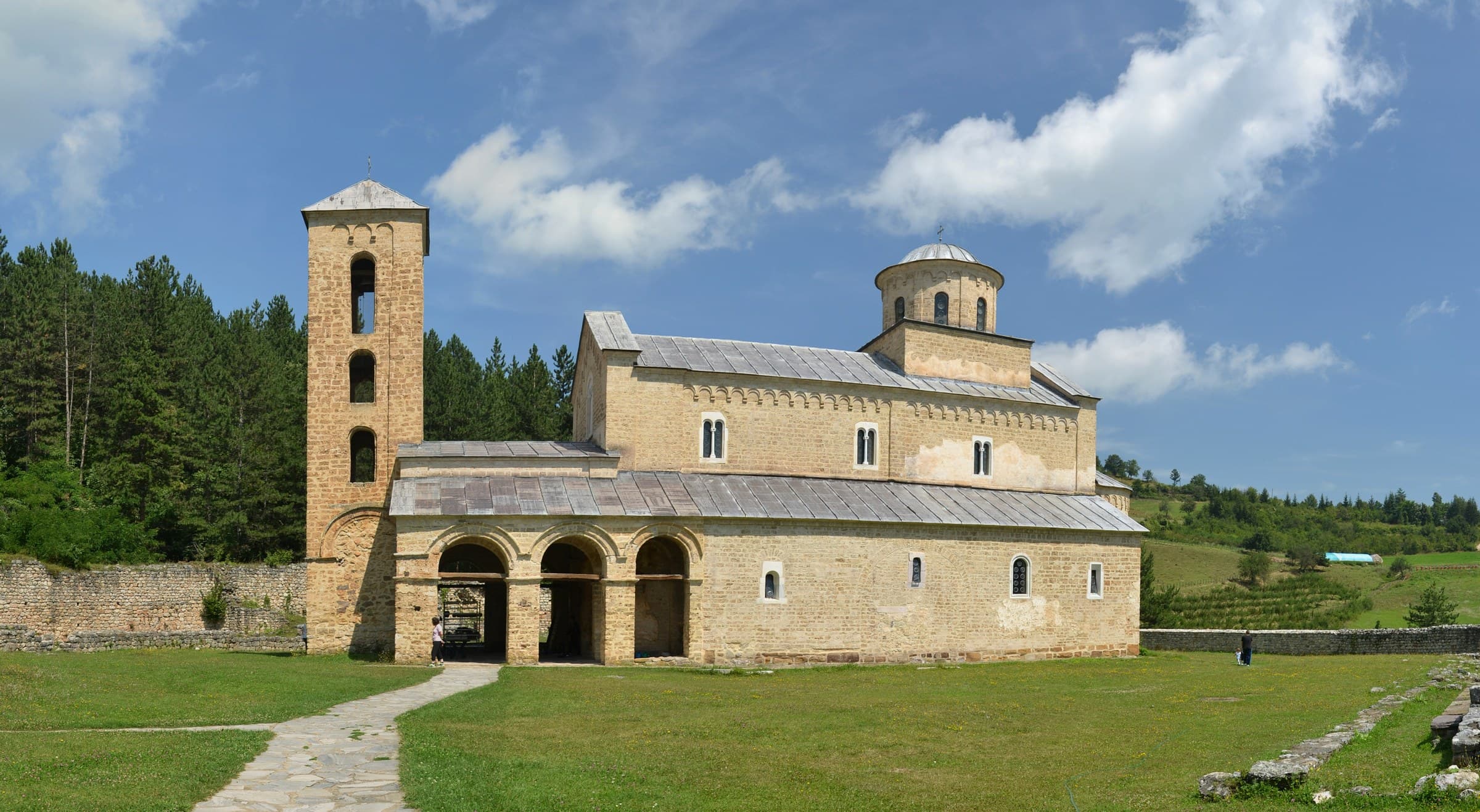
Sopoćani Monastery
Royal foundation of King Uroš I from about 1260, UNESCO-listed for its wall painting
Stand beneath the Dormition of the Virgin on the west wall and let your eyes adjust; it rewards a long look.

In 60 seconds
Novi Pazar holds two histories at once, within a few kilometres of each other. The valley around it was Ras, the seat from which the medieval Serbian state grew, and three of its churches — Sopoćani, Đurđevi Stupovi and the Church of Saints Peter and Paul — carry UNESCO listing together with the fortress ruins above them. The town itself was laid out under Ottoman rule in the fifteenth century and is still built around its bazaar, its hammam and the Altun-alem Mosque, and is the cultural centre of the Sandžak. The result is a place where a tenth-century episcopal church and a working ćevapi grill of eighty years' standing are a short walk apart, and where both are treated as ordinary.
Best for
Known for
Skip if
You want a polished tourist town; Novi Pazar is a working regional city and its appeal is in its layers, not its surface.
Your match
Choose a few travel interests and we will show how well Novi Pazar fits them. Choose interests
See
The things that would make the trip incomplete without them.
Royal foundation of King Uroš I from about 1260, UNESCO-listed for its wall painting
Stand beneath the Dormition of the Virgin on the west wall and let your eyes adjust; it rewards a long look.
Round stone church on a hillside terrace above the town, over a 10th-century episcopal site
Walk up rather than drive, and look at the masonry: this is the oldest standing church fabric in the country.
Ruined hilltop monastery of Saint George founded by Stefan Nemanja around 1170
Climb the last stretch on foot at the end of the day for the long view down the Raška valley.
Well-preserved 16th-century mosque with a stone minaret and a double-domed prayer hall
The courtyard is the quietest corner of the bazaar quarter; enter respectfully and outside prayer times.
Regional museum of the Raška valley, from Neolithic finds to Sandžak craft and dress
Start here before the monasteries; the valley's chronology makes far more sense afterwards.
Eat
A short list, kept short on purpose. Each entry answers one question: when is this the right choice?
Too few picks yet for their own heading, so they share this list.
Grill house at the head of the corso with some eighty years of ćevapi behind it
Order ćevapi in the bun with kajmak and a glass of sheep's soured milk, and skip everything else on the card.
Bakery counters in the old quarter selling the small meat-filled mantije of the Sandžak
Buy mantije by weight in the morning, while the trays are still coming out of the oven.
Old-quarter pastry shops selling baklava, tufahije and Turkish coffee in small cups
Have the coffee unsweetened alongside the baklava; that is how it is meant to balance.
Beyond the obvious
Less obvious, rarely queued for, and usually the part people remember.
Remains of a 15th-century Ottoman bath house near the centre, with its domes still legible
Look up at the pierced domes; the star-shaped openings once lit the steam rooms below.
Ruined fortress of the medieval Serbian seat of Ras, reached by a steep walk above the valley
A genuine scramble, and almost always empty; take water and sturdy shoes rather than a guidebook.
Orientation
How the city is actually divided, and what each part is for.
The old bazaar quarter: low shopfronts, bakeries, the hammam and the Altun-alem Mosque
Come mid-morning on a weekday, when the workshops are open and the quarter is doing its actual job.
Stay
Areas rather than hotels — pick the right one and the rest follows.
Hotels and guesthouses around the corso, walking distance from the bazaar and the bus station
Stay central and hire a car or a driver for the monasteries; they are scattered across the valley.
Practical
Context
Enough to make what you are looking at legible.
An episcopal church stood on the site of the present Church of Saints Peter and Paul, among the earliest recorded in the region.
The valley of Ras was a seat of the Nemanjić rulers; Đurđevi Stupovi was founded around 1170 and Sopoćani around 1260.
Under Ottoman rule a new market town, Yeni Pazar, was laid out below the old fortress and became the regional centre.
Incorporated into Serbia after the Balkan Wars, the town remained the cultural and commercial centre of the Sandžak.
Stari Ras and Sopoćani were inscribed on the UNESCO World Heritage List as a single group of monuments.
Further out
Worth a day if you have one to spare.
Stefan Nemanja's marble-faced monastery of 1190, the richest of the medieval Serbian foundations
Pair it with Sopoćani on separate days; seeing both in one afternoon does justice to neither.
Small thermal spa on the edge of town, in use since Ottoman times
Entirely unglamorous and entirely local; go for the hot mineral water rather than the setting.