
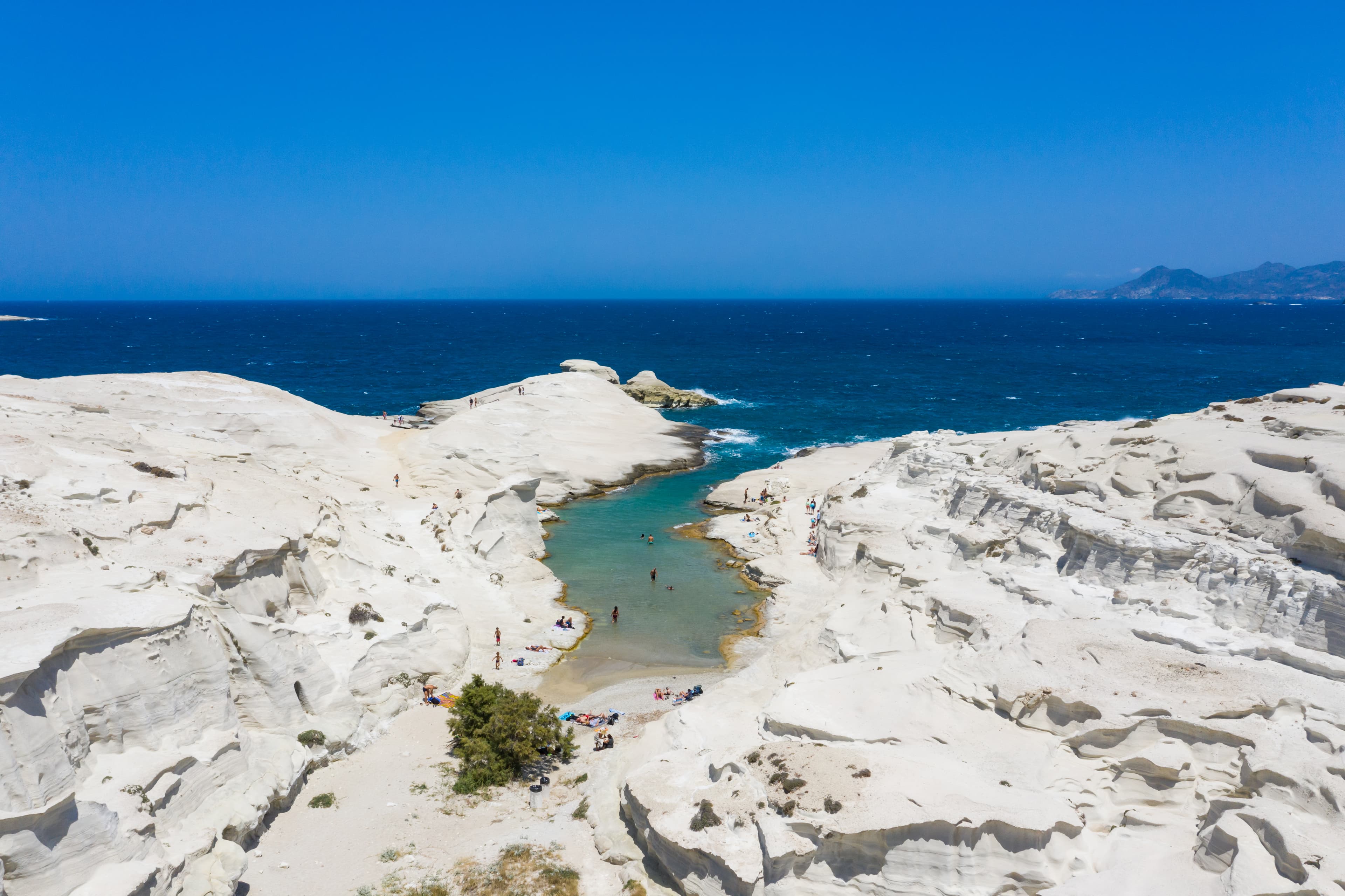
Sarakiniko Lunar Beach
Surreal bone-white volcanic pumice rock formations and turquoise sea canal
Wind-eroded chalk-white volcanic rock creates an otherworldly lunar topography with natural diving platforms into electric-blue water.

In 60 seconds
Milos is the geological masterpiece of the Aegean, shaped by millions of years of volcanic activity into a surreal coastline of over seventy distinct beaches. Its defining icon is Sarakiniko, where bone-white volcanic pumice cliffs form a lunar landscape plunging into sapphire waters. Along sheltered water inlets sit traditional fishing hamlets like Klima and Mandrakia, famous for 'syrmata'—two-storey boathouses painted in vivid primary colours right on the water's edge. Sailing around the southwest sea cliffs reveals Kleftiko, an astonishing labyrinth of towering white sea stacks and pirate arches.
Best for
Known for
Skip if
You dislike travelling by small boat or expect lush green forests rather than dramatic, sun-bleached volcanic mineral geology.
Your match
Choose a few travel interests and we will show how well Milos fits them. Choose interests
See
The things that would make the trip incomplete without them.
Surreal bone-white volcanic pumice rock formations and turquoise sea canal
Wind-eroded chalk-white volcanic rock creates an otherworldly lunar topography with natural diving platforms into electric-blue water.
Towering white limestone and pumice sea arches accessible by boat
An ancient pirate lair of majestic white stone arches, tunnels and crystalline waters best explored by sailing boat and mask.
Traditional waterfront fishing hamlet of rainbow-painted 'syrmata'
Two-storey fishermen's boathouses with brightly painted doors and balconies sit directly on the water's edge as waves lap stone thresholds.
Eat
A short list, kept short on purpose. Each entry answers one question: when is this the right choice?
Mornings, and the slow hour between things.
Traditional bakery in Plaka specializing in watermelon pie
Sample Milos's signature 'karpouzopita' (spiced baked watermelon pie with sesame and honey) alongside iced Greek coffee in a quiet lane.
Cliff-edge sunset café in Plaka with dramatic sea views
Perched on the western cliffs of Plaka, this terrace fills with travellers sipping afternoon espresso and sunset aperitifs.
Too few picks yet for their own heading, so they share this list.
Farmstead taverna with handwritten dialect menus beside Papikinou beach
Produces its own cheeses and meats on its mountain farm, serving slow-roasted goat in parchment paper in a leafy shaded courtyard.
Sunset dining on the shoreline of colourful Klima
Tables positioned centimetres from the Aegean surf offer fresh catches and chilled Greek wine as the sun melts directly into the sea.
Celebrated seaside seafood taverna right above Mandrakia cove
Dine on sun-dried grilled octopus, smoked eel and marinated anchovies while listening to the sea lap against the pastel boathouses below.
Beyond the obvious
Less obvious, rarely queued for, and usually the part people remember.
Intimate northern cove of boat garages and fresh octopus drying on lines
A peaceful rocky inlet where fishermen tie up beside pastel boat houses, famous for drying octopus in the breeze right beside the sea.
1st-century underground subterranean Christian burial corridors
One of the oldest and most extensive early Christian underground burial complexes in the world, carved directly into volcanic tufa rock.
The highest hilltop peak in Plaka crowned by the Panagia Thalassitra church
Climb the whitewashed stepped paths through Plaka to the ruined 13th-century Venetian castle for panoramic 360-degree sunset views across the gulf.
After dark
Harbourside cocktail terrace overlooking the yachts in Adamas
Relax on comfortable waterfront cushions watching the evening ferry arrivals while enjoying Mediterranean fruit cocktails.
Orientation
How the city is actually divided, and what each part is for.
The whitewashed hilltop capital of car-free stone alleys and sunsets
A classic Cycladic village of narrow paved streets, bougainvillea, folk museums and romantic cliffside viewpoints.
Charming northeast fishing harbour lined with seaside tamarisk trees
A sophisticated yet tranquil fishing village known for sandy beaches, refined fish restaurants and ferry boats to neighbouring Kimolos.
The primary ferry harbour and sailing catamaran hub
A bustling bayside town that serves as the island's commercial centre, departure point for round-island boat tours, and transit hub.
Stay
Areas rather than hotels — pick the right one and the rest follows.
Upscale seaside suites and boutique hotels near calm swimming beaches
The most refined base on the island, offering quiet evenings, high-calibre dining and walkable sandy shores.
Traditional Cycladic whitewashed stays with sunset vistas
Ideal for travellers who love authentic village strolls, historic catacombs and walking to evening cliffside cocktail terraces.
Practical
Plan this trip — useful links
Context
Enough to make what you are looking at legible.
A local farmer named Yorgos Kentrotas uncovers the legendary 2nd-century BC marble statue of Aphrodite (Venus de Milo), now in the Louvre in Paris.
Athens besieges and conquers neutral Milos during the Peloponnesian War, an event dramatized in Thucydides' famous 'Melian Dialogue'.
Early Christians carve extensive subterranean catacomb galleries and burial vaults into the volcanic tufa rock near modern Trypiti.
Further out
Worth a day if you have one to spare.
Unspoiled chalk-white sister island of Chorio village and Prassa beach
Hop across the narrow strait on the local open ferry to experience an intensely peaceful island of chalk cliffs and clear bays.
Secluded sandy cove accessed via a wooden ladder through a rock cleft
An adventurous descent using ropes down a narrow sandstone chimney opens onto an unforgettable emerald cove enclosed by sheer cliffs.
19th-century neoclassical museum housing a plaster cast of the Venus de Milo
Located in an elegant Ernst Ziller building, showcasing a pristine replica of the Venus de Milo, discovered on the island in 1820.