

Rynok Square & City Hall Tower
Central market square framed by Renaissance and Baroque burgher houses
Climb the nineteenth-century Ratusha tower to read the distinct quarters of the old walled city from above.
In 60 seconds
Lviv's UNESCO-listed historic centre preserves the street plan of a central European trading city where Ukrainian, Polish, Armenian, Jewish and Austrian traditions met. Around Rynok Square, forty-four townhouse facades conceal arcaded Italianate courtyards, while the Armenian Cathedral, Latin Cathedral and Korniakt Tower stand within steps of one another. Take time to explore the Secessionist boulevards, Lychakiv Cemetery and the wooden churches of Shevchenkivskyi Hai.
Best for
Known for
Skip if
Even in western Ukraine, air-raid alerts and curfews remain part of wartime reality.
Your match
Choose a few travel interests and we will show how well Lviv fits them. Choose interests
See
The things that would make the trip incomplete without them.
Central market square framed by Renaissance and Baroque burgher houses
Climb the nineteenth-century Ratusha tower to read the distinct quarters of the old walled city from above.
Fourteenth-century cathedral with twentieth-century murals by Jan Henryk Rosen
Enter through the stone courtyard paved with centuries-old Armenian tombstones.
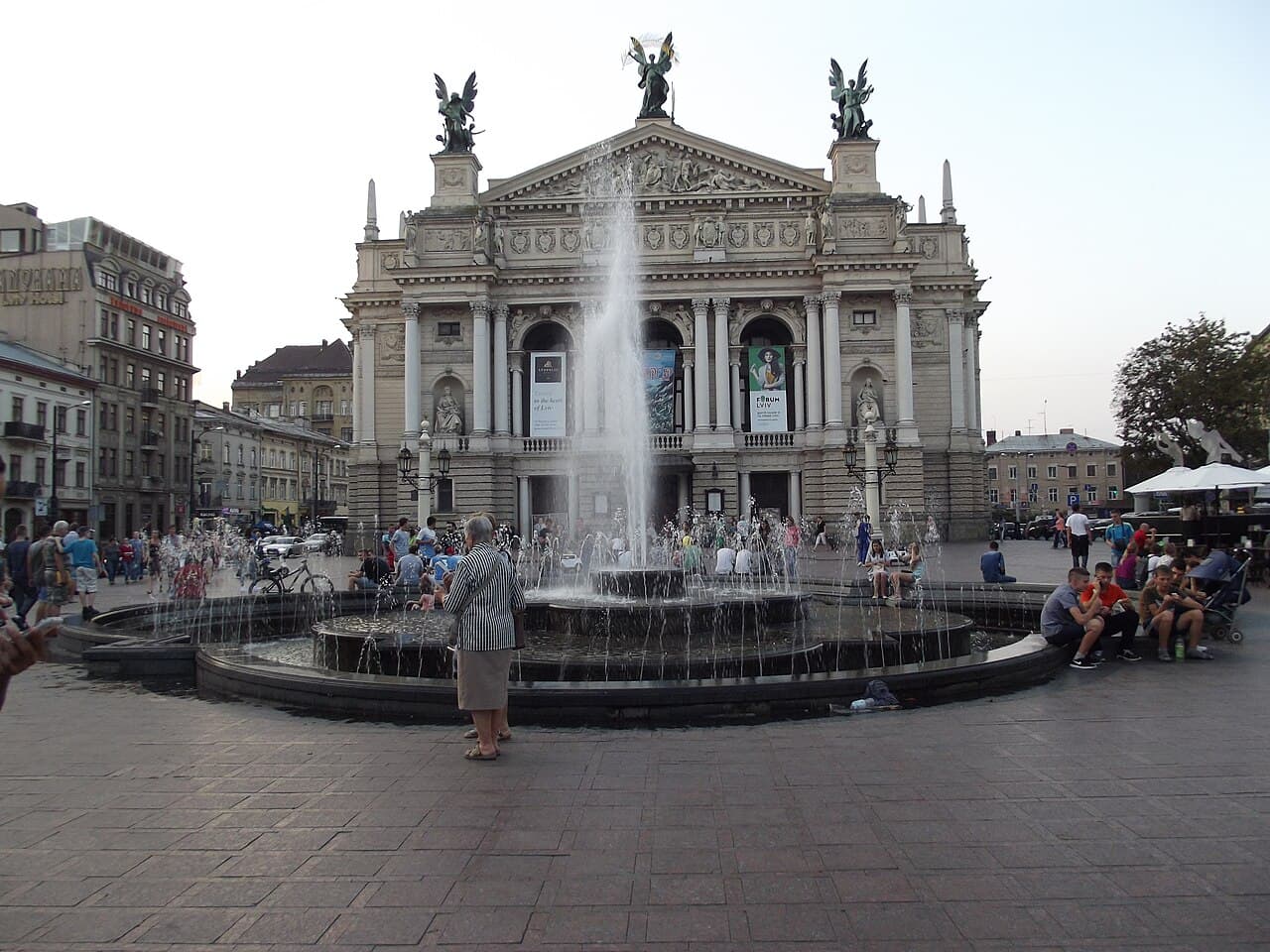
1900 Neo-Renaissance theatre on tree-lined Svobody Prospekt
Step inside for the Hall of Mirrors and Henryk Siemiradzki's painted stage curtain.
Renaissance Orthodox ensemble built by the Lviv Dormition Brotherhood
Admire the carved stone frieze and sixty-five-metre bell tower on Ruska Street.
Beyond the obvious
Less obvious, rarely queued for, and usually the part people remember.
Landscaped nineteenth-century necropolis of writers, composers and scholars
Walk the shaded avenues to see sculptural tombs of Ivan Franko and Solomiya Krushelnytska.
Open-air museum of Carpathian wooden architecture in the Kaiserwald hills
Includes Boyko, Lemko and Hutsul timber churches and farmsteads.
Memorial site at the ruined Golden Rose Synagogue
Quietly honours Lviv's pre-Holocaust Jewish community through engraved quotations and preserved foundations.
Practical
Context
Enough to make what you are looking at legible.
Founded by King Danylo of Galicia and named for his son Lev, the city grows as a crossroads on the Black Sea–Baltic trade route.
As capital of Habsburg Galicia and Lodomeria, Lviv gains its opera house, university buildings, railways and coffeehouse culture.