
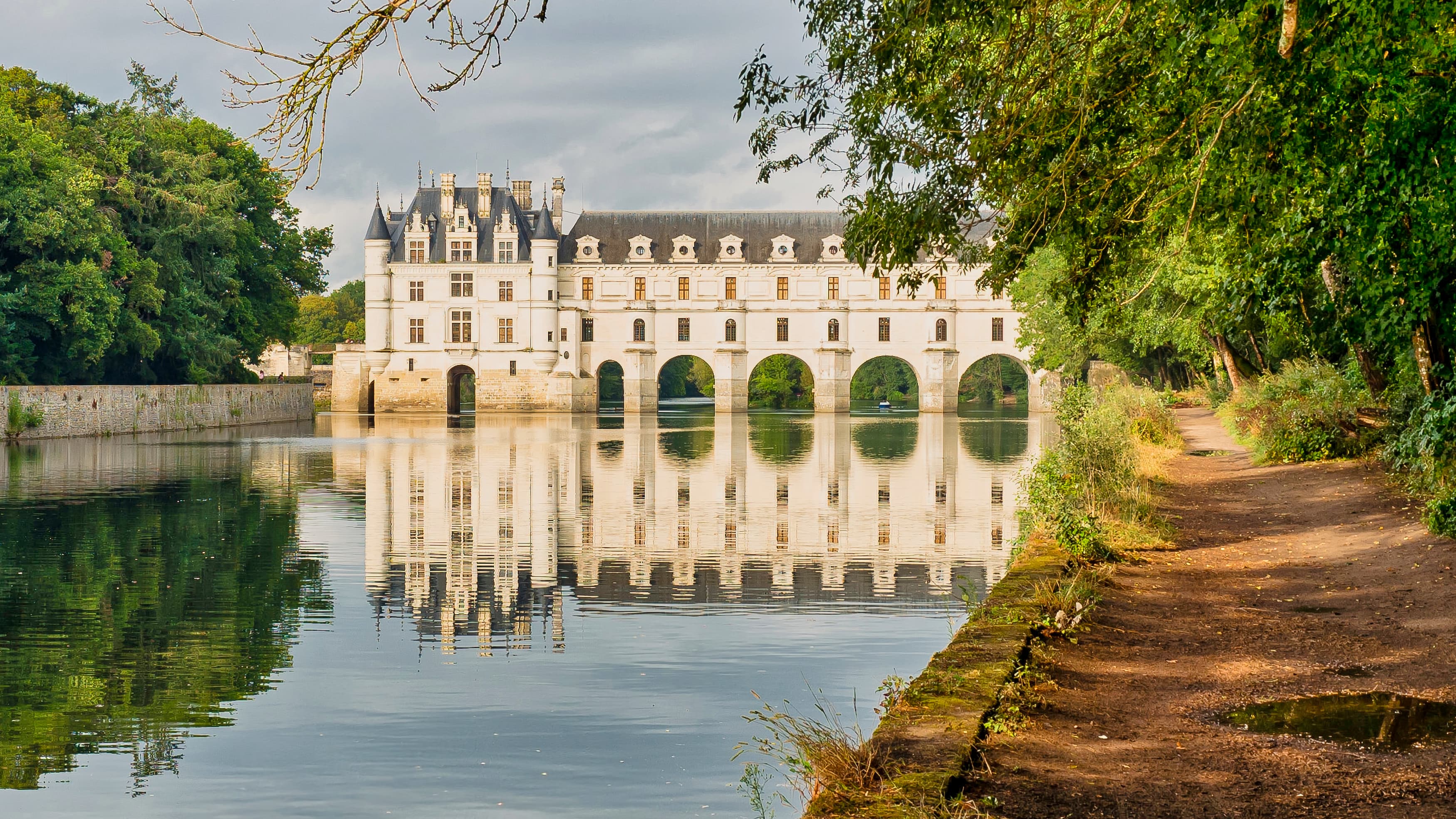
Château de Chenonceau
ExpensiveThe 'Château des Dames' spanning the river Cher with gallery arches
An exquisite Renaissance castle built directly over the river Cher, shaped by powerful women including Diane de Poitiers and Catherine de' Medici.

In 60 seconds
Stretching along France's last wild river, the UNESCO-inscribed Loire Valley represents the pinnacle of French Renaissance courtly architecture, royal gardens, and refined living. Based from the cathedral city of Tours or riverside Amboise, travellers can easily explore the valley's four greatest architectural anchors: Chenonceau gracefully arching over the river Cher, the colossal hunting palace of Chambord with its double-helix staircase, the royal fortress of Amboise where Leonardo da Vinci spent his final years, and the terraced Renaissance gardens of Villandry. Shaded riverside cycle paths along the Loire à Vélo route, troglodyte wine cellars, and crisp Chenin Blanc and Cabernet Franc wines complete this timeless French landscape.
Best for
Known for
Skip if
You want to rush through ten castles in a single day; the valley is best experienced by lingering at three or four major estates and exploring the riverbanks.
Your match
Choose a few travel interests and we will show how well Loire Valley Châteaux fits them. Choose interests
See
The things that would make the trip incomplete without them.
The 'Château des Dames' spanning the river Cher with gallery arches
An exquisite Renaissance castle built directly over the river Cher, shaped by powerful women including Diane de Poitiers and Catherine de' Medici.
Colossal Renaissance hunting estate & double-helix staircase
Francis I's breathtaking masterwork set in a walled forest park, crowned by a fantasy rooftop of lantern turrets and Leonardo's ingenious spiral stair.
Royal fortress above the Loire & tomb of Leonardo da Vinci
Perched high on a rocky spur overlooking the Loire, this royal palace houses the Saint-Hubert chapel where Leonardo da Vinci is buried.
Famed Renaissance geometric vegetable and ornamental water gardens
Six grand tiers of geometric gardens featuring a world-renowned ornamental kitchen garden with multicoloured geometric vegetable parterres.
Eat
A short list, kept short on purpose. Each entry answers one question: when is this the right choice?
Too few picks yet for their own heading, so they share this list.
Touraine gastronomic covered market & lunch counters
The culinary temple of Touraine, where food stalls and market bistros serve pork rillons, rillettes de Tours, and ash-coated Sainte-Maure goat cheese.
Traditional bistro facing the Amboise castle ramparts
A classic French bistro terrace set directly below the royal ramparts, offering Loire fish in white butter sauce and regional carafes.
Historic 18th-century coaching inn dining in Chenonceaux
A charming stone coaching inn dating from 1786 steps from Château de Chenonceau, serving refined Touraine cooking and regional Vouvray and Chinon wines.
Historic terrace café under the mulberry tree on Place Plumereau
The classic meeting place in old Tours, shaded by a historic mulberry tree on the cobbled pedestrian square.
Beyond the obvious
Less obvious, rarely queued for, and usually the part people remember.
Leonardo da Vinci's final residence & working invention models
A red-brick manor house connected by legend via secret tunnel to the royal castle, displaying life-sized models of Leonardo's visionary engineering machines.
Pedestrian square surrounded by 15th-century corbelled timber houses
The lively social hub of Tours old town, filled with café terraces set against ornate half-timbered merchant facades.
After dark
Troglodyte cliffside cellars pouring sparkling and still Chenin Blanc
Carved directly into the limestone tuffeau cliffs on the north bank of the Loire, these cool subterranean galleries showcase Vouvray's versatile Chenin.
Orientation
How the city is actually divided, and what each part is for.
Medieval timbered houses, Gothic cathedral & river promenades
The lively urban core of Touraine, mixing pedestrian café squares with the monumental Gothic facade of Saint-Gatien Cathedral.
Riverside stone lanes directly below the royal castle spur
An idyllic small-town base where cobblestone pedestrian alleys hug the base of the massive castle walls along the Loire.
Stay
Areas rather than hotels — pick the right one and the rest follows.
Best central transport base with direct trains to Paris and châteaux
The most practical base for exploring without a car, offering rapid rail connections, rental car depots, and lively evening dining.
Romantic riverside atmosphere with castle views
An enchanting small-town alternative offering quiet evenings beneath illuminated ramparts within short driving distance of Chenonceau.
Practical
Plan this trip — useful links
Context
Enough to make what you are looking at legible.
During the Hundred Years' War and the Renaissance, French kings relocated their royal court from Paris to the protected Loire Valley estates.
Francis I invites Leonardo da Vinci to Amboise, who crosses the Alps carrying the Mona Lisa and resides at Clos Lucé until his death.
UNESCO inscribes the Loire Valley between Sully-sur-Loire and Chalonnes as a World Heritage cultural landscape for its exceptional architectural heritage.
Further out
Worth a day if you have one to spare.
Medieval fortress above the Vienne river & Cabernet Franc cellars
A dramatic medieval fortress where Joan of Arc first met the future King Charles VII, overlooking steep stone lanes and ruby red wine cellars.
Delicate early French Renaissance jewel mirrored in the Indre river
A fairy-tale palace set on an island in the Indre river, celebrated for its Italianate loggias reflected in tranquil moat waters.