

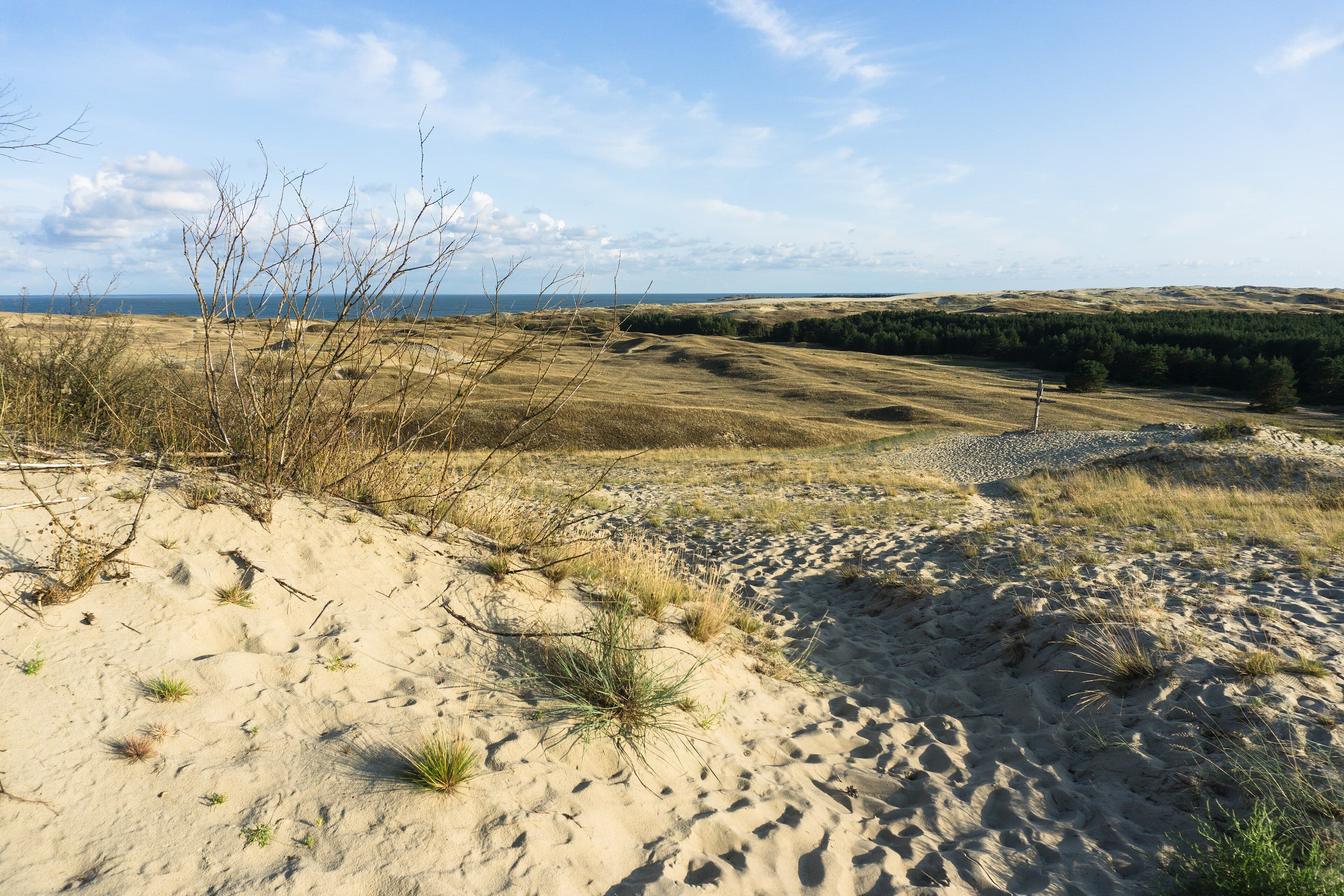
Curonian Spit National Park (Efa Height & Dancing Forest)
Transboundary UNESCO World Heritage sand-dune peninsula between lagoon and Baltic Sea
Walk the timber boardwalks up sixty-metre Efa Dune and visit the Rybachy ornithological station.
In 60 seconds
On the southeastern Baltic coast, the Kaliningrad region links the brick Gothic Königsberg Cathedral and Immanuel Kant's tomb on Kneiphof Island with the ninety-eight-kilometre UNESCO-listed Curonian Spit (shared across the border with Lithuania) and the turn-of-the-century coastal villas of Zelenogradsk and Svetlogorsk.
Best for
Known for
Skip if
You expect an intact pre-war Königsberg; only select monuments and villa quarters survived 1945.
Your match
Choose a few travel interests and we will show how well Kaliningrad & Curonian Spit fits them. Choose interests
See
The things that would make the trip incomplete without them.
Transboundary UNESCO World Heritage sand-dune peninsula between lagoon and Baltic Sea
Walk the timber boardwalks up sixty-metre Efa Dune and visit the Rybachy ornithological station.
Fourteenth-century brick Gothic cathedral on Kneiphof (Kant) Island in the Pregolya River
Houses the Kant Museum and the philosopher's 1924 columned memorial portico by Friedrich Lahrs.
Former East Prussian seaside towns of Cranz and Rauschen
Stroll under coastal pines past early twentieth-century half-timbered villas and the 1907 Svetlogorsk bathhouse tower.
Beyond the obvious
Less obvious, rarely queued for, and usually the part people remember.
Early twentieth-century garden-city neighbourhood in western Kaliningrad
Designed around winding tree-lined streets and Jugendstil villas by Friedrich Heitmann.
Historic research vessels on the Pregolya and Baltic amber collection in the 1853 Dohna Tower
Contextualises the Baltic coast's maritime and geological history.