

Mosque-Cathedral (Mezquita)
ModerateThe Great Mosque of the caliphs · UNESCO
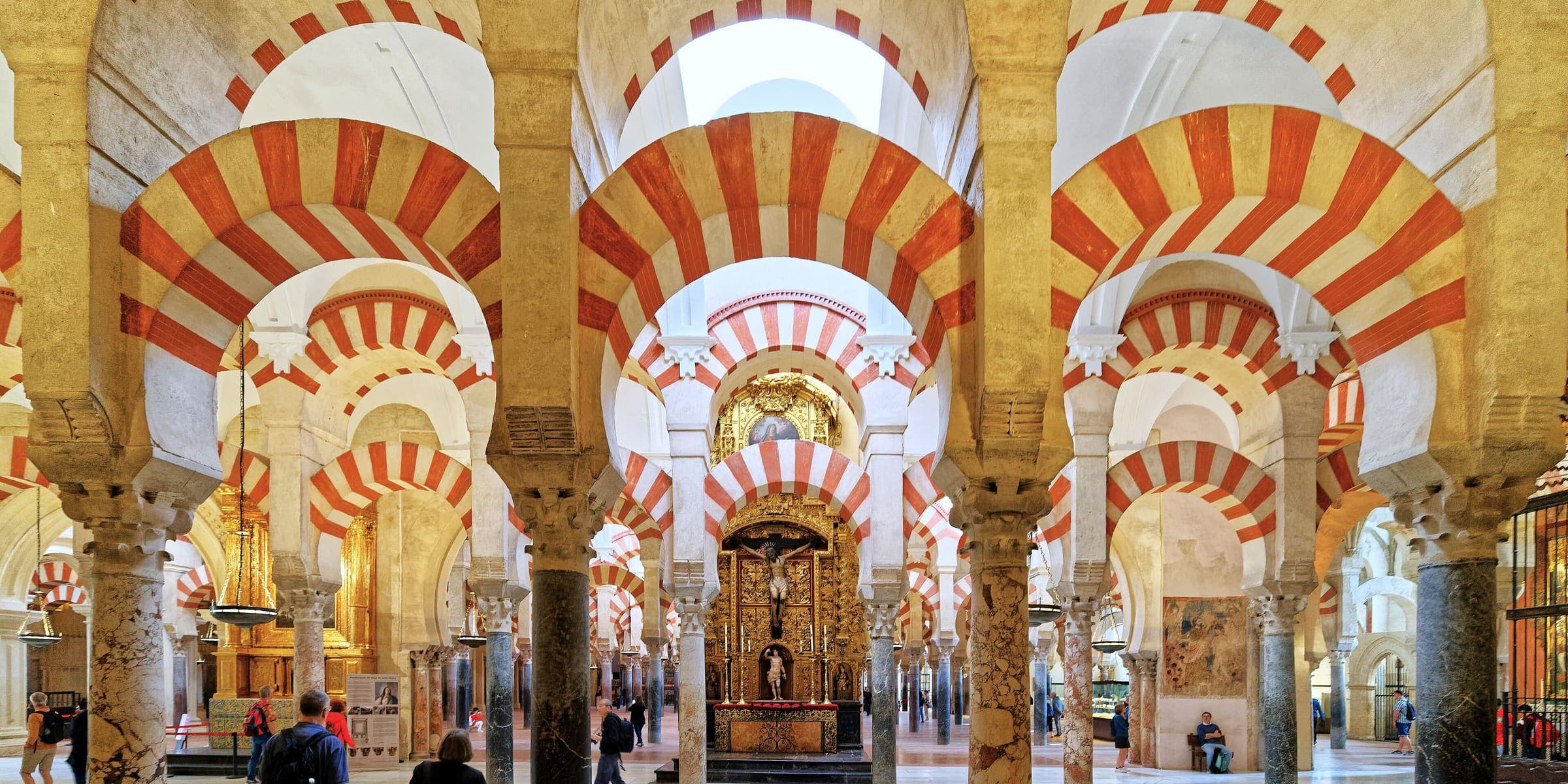
Walk into the half-light among the striped arches, then come upon the cathedral at its heart; go at opening time, or on the night visit.
JuderíaMust-seeUNESCO
In 60 seconds
A thousand years ago Córdoba was the capital of Islamic Spain and one of the largest cities in Europe, and its Great Mosque — the Mezquita — is the proof: a forest of more than 800 columns carrying double arches of red brick and white stone, with a Renaissance cathedral built into the middle of it after the Christian conquest. Around it the Judería, the old Jewish quarter, is a tangle of whitewashed lanes, and in May the city's private patios open their gates in a festival of geraniums and fountains. Cross the Roman bridge at sunset, visit the gardens of the Alcázar, and drive out to the ruined caliphal palace city of Medina Azahara. Córdoba invented salmorejo, the thick cold tomato soup, and fries a fine aubergine. Two days; avoid July and August, when it bakes.
Best for
Known for
Skip if
You are travelling in July or August — Córdoba is one of the hottest cities in Europe, and the afternoons are for hiding indoors.
Your match
Choose a few travel interests and we will show how well Córdoba fits them. Choose interests
See
The things that would make the trip incomplete without them.
The Great Mosque of the caliphs · UNESCO
Walk into the half-light among the striped arches, then come upon the cathedral at its heart; go at opening time, or on the night visit.
Fortress and terraced gardens
Long pools, cypresses and orange trees below the walls where Ferdinand and Isabella received Columbus.
Ruined palace city of the caliphs · UNESCO
The 10th-century palace city, abandoned within a lifetime, excavated on a hillside eight kilometres west; a bus runs from town.
Eat
A short list, kept short on purpose. Each entry answers one question: when is this the right choice?
Where to eat the food this city is actually known for.
Wine house and restaurant since 1908
Salmorejo, flamenquín and oxtail in a rambling old bodega of patios and barrels signed by famous guests.
Taberna with a roof terrace by the Mezquita
Tapas downstairs, a roof terrace with a view of the Mezquita's tower above.
Beyond the obvious
Less obvious, rarely queued for, and usually the part people remember.
Private courtyards full of flowers
Whitewashed courtyards hung with hundreds of pots; in May they open for the patio festival, and some open all year.
Across the Guadalquivir to the Calahorra tower
Walk across as the sun drops behind the Mezquita, and look back from the Calahorra tower.
Orientation
How the city is actually divided, and what each part is for.
The old Jewish quarter
Whitewashed lanes, the little medieval synagogue and the flower-hung Calleja de las Flores.
Stay
Areas rather than hotels — pick the right one and the rest follows.
Patio hotels near the Mezquita
Stay in a house built round a patio, a few minutes from the Mezquita.
Practical
Plan this trip — useful links
Context
Enough to make what you are looking at legible.
Abd al-Rahman I begins the Great Mosque.
Work begins on Medina Azahara, the caliph's palace city.
Ferdinand III takes Córdoba; the mosque becomes a cathedral.
Work begins on the cathedral nave inside the mosque.
Further out
Worth a day if you have one to spare.
Andalusia's capital
Seville has its own guide.
The Alhambra
Granada has its own guide.